


The Great Florida Rebalance: 5 Surprising Realities of the 2026 Housing Market
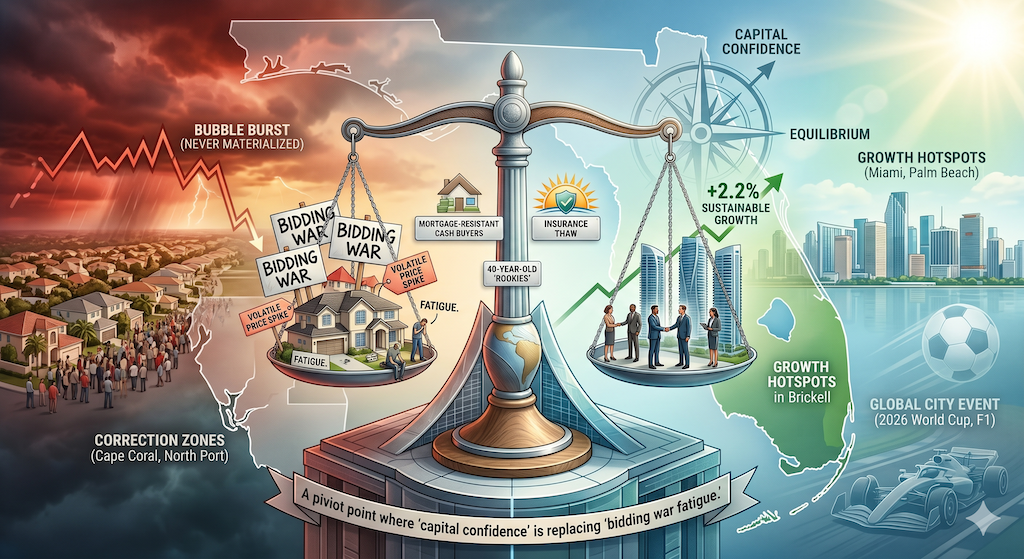
By the second quarter of 2026, the Florida housing market has transitioned into a complex "Great Rebalance." Market bears who anticipated a systemic collapse following the pandemic-era frenzy have been proven wrong; however, the days of irrational exuberance and double-digit price spikes have similarly vanished. We are no longer observing a monolithic "Florida Boom," but rather a nuanced, "two-speed market" where institutional liquidity and regional divergence dictate the winners.
The prevailing mystery for investors and residents alike is whether Florida remains a land of tactical opportunity or if the window has finally closed for the mainstream buyer. As a strategist, I view 2026 as a year of stabilization—a pivot point where "capital confidence" is replacing "bidding war fatigue."
Here are the five surprising realities defining the 2026 Florida real estate landscape.
--------------------------------------------------------------------------------
1. The "Crash" That Never Materialized: Normalization as the New Growth
For years, critics pointed to rising inventory and cooling sales as harbingers of a bubble burst. Instead, the market has executed a "soft landing" into a phase of modest appreciation. Statewide, home prices are projected to grow by a controlled 2.2% in 2026, a stark contrast to the volatile jumps of 2021–2023.
Dr. Brad O’Connor, Chief Economist for Florida Realtors, characterizes this shift as a "balanced and opportunity-rich phase." We are seeing the fading of the "lock-in effect," where homeowners previously clung to sub-3% mortgage rates. As rates have stabilized between 6.0% and 6.5%, the inventory surge—now exceeding 162,000 active listings—is fueling a volume recovery rather than a price collapse. Dr. Jessica Lautz of the National Association of Realtors notes the market is finally moving in a "constructive direction," shifting from a "stuck in second gear" stalemate to a functional equilibrium.
2. The 40-Year-Old "Rookie": A Demographic Pivot
The profile of the Florida homebuyer has undergone a structural transformation. The "rookie" first-time buyer is no longer a young family starting out; the median age for a first-time purchase has climbed to 40 years old. This demographic now represents just 21% of total transactions.
This signals a move toward a "mortgage-resistant" market dominated by established professionals and wealth-migrants. Strategic data points to note:
- Liquidity Over Debt: Cash buyers now account for nearly one-third of all transactions statewide. In the Miami MSA, this figure reaches a dominant 44%, insulating the luxury tier from interest rate sensitivity.
- The Missing Middle: While younger families face affordability hurdles, the "Missing Middle" is being partially backfilled by a younger, high-earning workforce. In Broward County, 55% of new movers are under the age of 44, often relocating for sector-specific professional growth rather than retirement.
3. The 2026 Sports Boomerang: Branding a Global City
Florida is leveraging a rare concentration of global sporting events in 2026 to drive "repeat visitor conversion." This is not a temporary tourism spike; it is a structural mechanism that builds "capital confidence" among institutional and international investors.
The impact is geographically concentrated in Brickell, Downtown Miami, and Miami Beach, districts with the hospitality infrastructure to capture high-net-worth attention during the following events:
- FIFA World Cup: Miami hosts seven matches, creating a sustained month-long visitor cycle.
- F1 Miami Grand Prix: Reinforces luxury "brand equity" and drives demand for branded residences.
- NHL Winter Classic & Miami Open: Maintain global visibility through the Q1 "buying season."
The "Sports Boomerang" effect converts these visitors into short-term renters and, eventually, long-term residents, effectively repricing Miami as a global tier-one city on par with London or Singapore.
4. The Surprising "Thaw" in Property Insurance
The narrative of "Florida fatigue" was largely driven by a collapsing insurance market. In 2026, we are seeing the first real signs of a thaw following the 2022/2023 legislative reforms.
While premiums remain high—often double the national average—the private market's renewed confidence is evident:
- Market Entry: 17 new insurers have entered the state, reintroducing competition.
- Citizens Depopulation: The state-backed Citizens Property Insurance has dropped below 400,000 policies, shifting risk back to private carriers.
- Stabilization: Premium growth has "slowed sharply." While still a significant carrying cost, the predictability of these costs allows for more accurate underwriting and investment modeling.
5. The "Two-Speed" Market: Regional Divergence
Florida is no longer a monolith. We are witnessing a sharp rift between "Growth Hotspots" and "Correction Zones." Furthermore, high-level investors must look past average prices to see the underlying softening in mainstream segments.
|
Market Category |
Region |
Performance Detail |
Strategic Nuance |
|
Growth Hotspot |
Miami-Dade |
$1M+ sales climbed 21%. |
Miami is #1 in the South for occupancy and rent growth (0.7%). |
|
Growth Hotspot |
Palm Beach |
Avg. price up 11% (to $1.025M). |
Median price up 3%; broad appreciation across all tiers. |
|
Two-Speed Zone |
Broward |
Avg. price surged 32%. |
Critical Nuance: Skewed by luxury outliers (>$1.5M); median price actually dropped 1%. |
|
Correction Zone |
Cape Coral |
Projected price decline: 10.2%. |
Supply overhang meets cooling Gulf Coast demand. |
|
Correction Zone |
North Port |
Projected price decline: 8.9%. |
Higher inventory levels are forcing price resets. |
While the Miami Metro Area outshines the South with its 6.6% vacancy rate, inland cities like Orlando and Tampa have seen rent declines of 0.8% and 2.7%, respectively, as completions outpace absorption.
--------------------------------------------------------------------------------
The Strategic Window: Concessions and Volume Recovery
The current climate presents a unique "Strategic Window" for those operating on liquidity. With 162,000+ listings and an average of 83 days on market, the leverage has shifted decisively toward the buyer. We have entered an era of concession negotiations—where sellers are increasingly open to covering closing costs or repairs to facilitate a deal.
Looking toward 2027 and 2028, we anticipate a period of "Volume Recovery" and "Normalization." As the "supply overhang" in correction zones is absorbed, the market will settle into a comfortable equilibrium defined by sustained, long-term growth rather than pandemic-driven frenzy.
In a market defined by selective corporate growth, high-standard governance, and global visibility, the question for 2026 is no longer about the "crash." It is a question of intent: In a rebalanced Florida, are you looking for a residential refuge, or are you securing a stake in the state's new global identity?
About the author
Roman Ivanov is a South Florida listing agent with Miami Fine Living by Roman Ivanov (Real Broker, LLC), helping homeowners sell condos and single-family homes in Aventura, Sunny Isles Beach, North Miami Beach and Hollywood. 160 career sales, licensed in Florida since 2014, 5.0 on Google, and fluent in English and Russian.
Thinking about selling? See how I sell homes in Aventura, Sunny Isles Beach, North Miami Beach and Hollywood, or get a free home value. Call or text (786) 909-4892.